



NAVIGATION
Table of contents
Over the years, I have seen protection teams that looked impressive but added surprisingly little to the principal’s actual security.
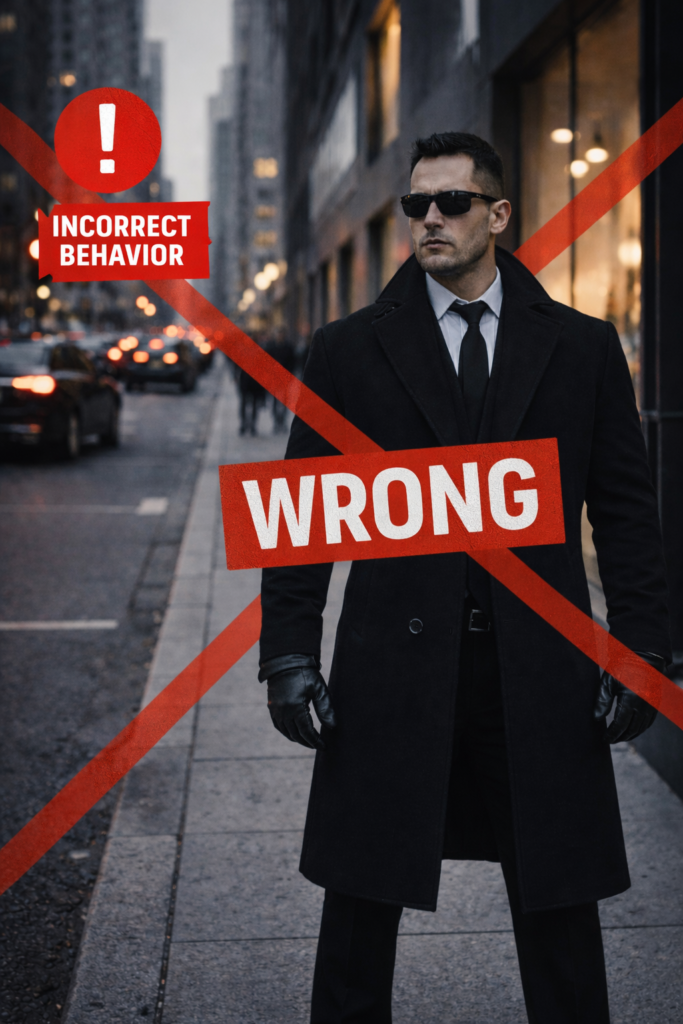
An officer remained constantly at the principal’s shoulder. Every movement was obvious. Public spaces were unnecessarily cleared. Instructions were loud, body language was overt and the protective presence became part of the spectacle.
To an outside observer, this can look like effective security.
It is not necessarily effective protection.
That does not mean visible protection is wrong. There are situations where an overt presence is entirely justified. It may deter unwanted approaches, reinforce access control, establish clear boundaries or simply reflect the assessed threat.
The point is that visibility should have a purpose.
The same applies to proximity, team size and protective posture. None of these demonstrates professionalism in itself. They should result from the threat, the environment, the principal’s activities and what the team is actually trying to achieve.
This is why I see effective executive protection primarily as a risk-management function rather than a demonstration of physical presence.
Protection starts before the principal arrives
Much of the work that determines whether an operation will run well takes place before the principal enters the environment.
Advance work is an obvious example.
Depending on the assignment, this may mean understanding how the venue actually functions, checking access and egress, reviewing vehicle movements, identifying potential chokepoints, considering medical and emergency arrangements, coordinating with local security and making sure there are realistic alternatives if the original plan no longer works.
None of this is particularly dramatic.
That is precisely the point.
Good advance work reduces uncertainty and gives the team options. It means fewer critical decisions have to be improvised once something starts going wrong.
I have always considered that more valuable than placing additional people around a principal simply because doing so appears more protective.
The question should not be: How much security can we visibly deploy?
It should be: What risks are we trying to manage, and what measures are actually required?
Sometimes the answer will involve a larger or more visible presence. Sometimes it will not.
Information has to change something
Physical protection is only one part of the picture.
A team can be very good at immediate response and still be operating too late if it has failed to recognise that the threat environment has changed.
Relevant indicators can come from many directions: online activity, direct or indirect threats, unusual interest in the principal, business disputes, employment issues, changes in public profile, exposure of an itinerary or information received from corporate security, local partners or law enforcement.
This is where protective intelligence becomes important.
Its value is not simply in gathering information. The real question is what that information changes.
Does it justify altering the route? Changing the venue or timings? Increasing team strength? Introducing additional screening? Reviewing transport arrangements? Moving from a discreet posture to something more overt?
That connection between information and protective action is what matters.
Protective posture should not remain fixed because “this is how we normally do it”. It should change when the risk changes.
In practice, identifying a developing problem early enough to avoid it will usually be preferable to demonstrating how effectively the team can respond once the problem has already reached the principal.
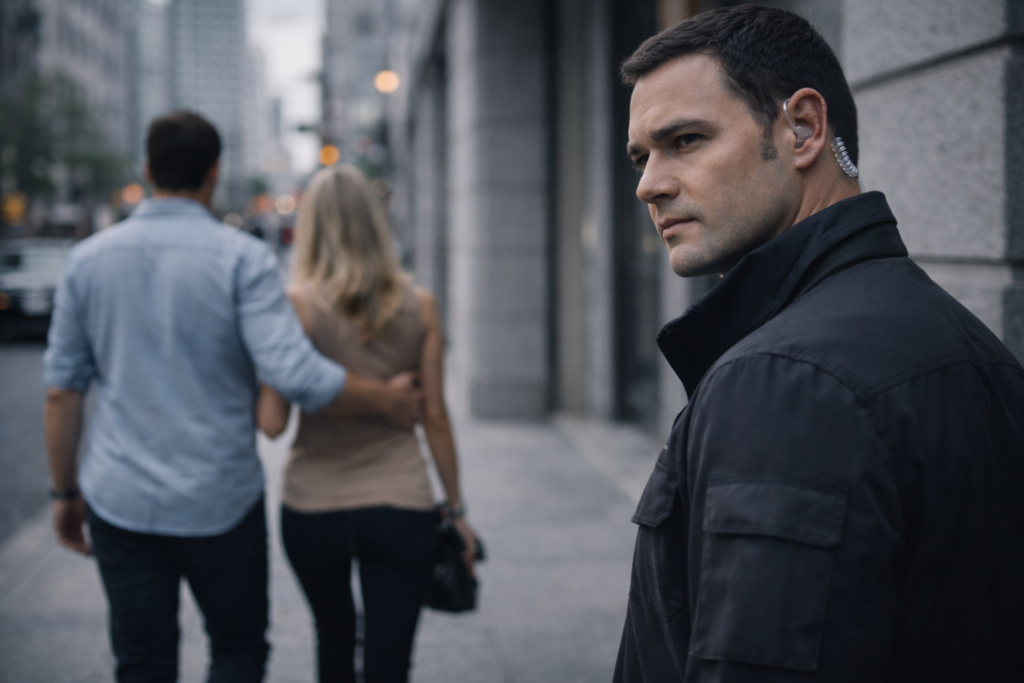
Judgement matters more than performance
Executive protection frequently requires decisions to be made under time pressure and with incomplete information.
But not every unexpected movement, unusual behaviour or raised voice is a threat.
Experience helps us recognise patterns more quickly. Models such as OODA or Recognition-Primed Decision Making can help explain some of that process, but knowing the terminology is far less important than being able to identify what matters, avoid premature conclusions and make a proportionate decision.
Experience is most valuable when it is combined with judgement.
Something may resemble a situation we have encountered before without actually presenting the same risk. A crowded lobby, an agitated individual or an unexpected itinerary change does not automatically require escalation.
Sometimes professional judgement is most visible in what the team chooses not to do.
The same applies to confrontation.
Anyone working in close protection must be capable of acting decisively when physical intervention becomes necessary. But not every developing problem should be allowed to reach that point.
Creating distance, changing position, moving the principal, slowing an interaction down or bringing another resource into the situation may offer a better solution.
That is not passivity. It is part of maintaining control.
Unnecessary confrontation brings its own risks: injury, legal consequences, reputational damage, disruption to the principal’s programme, crowd reaction and, potentially, loss of control over the movement itself.
A protection officer therefore needs more than the ability to intervene. They need the judgement to recognise whether intervention is actually the best available option.
This is particularly important in corporate executive protection, where the objective extends beyond preventing physical harm. Continuity, reputation, discretion and the principal’s ability to conduct business also matter.

The principal still has a job to do
This is something that can easily be forgotten when security begins to dominate the operation.
Executive protection exists to allow the principal to function.
A corporate executive still needs to attend meetings, visit facilities, speak with employees, travel, appear at public events and, in many cases, maintain a private life that does not feel like a permanent security operation.
Protection that constantly interferes with those objectives may reduce one category of risk while creating other problems.
This does not mean compromising security for convenience. It means designing protective measures around a realistic understanding of both the risk and the principal’s requirements.
The best protective arrangements often attract relatively little attention during routine activity because much of the difficult work has already been done. The team understands the environment, communications are clear, contingencies are realistic and people know their responsibilities.
If circumstances change, the posture can change with them.
That is a more mature approach than maintaining the same visible security footprint regardless of what is happening.
It also reflects the broader risk-based approach found in frameworks such as the ASIS Executive Protection Standard and ISO 31030:2021: protective measures should be driven by assessed risk, planning and proportionate mitigation rather than by a fixed security template.
Visibility is a tool
There are assignments where visible protection is exactly what is required.
A deliberate overt presence may discourage unwanted attention, reinforce access control or communicate an immediate capacity to respond.
In another environment, the same posture may be counterproductive. It can draw attention to the principal, complicate movement, increase tension or reveal more about the protective operation than necessary.
Neither approach is inherently more professional.
What matters is why it has been chosen.
A team may operate discreetly during routine movement, increase visibility at a particular venue and change posture again because new information alters the risk picture.
That is normal. Protective posture should evolve as circumstances change.
For me, the useful test is simple:
Does the protective operation genuinely reduce risk while allowing the principal to function, or does it mainly demonstrate that security is present?
The most effective protection professionals I have worked with are not defined by how visible they are. They are defined by preparation, judgement, situational awareness and the ability to adapt when circumstances change.
They understand when discretion provides an advantage, when visibility serves a purpose and when intervention is genuinely necessary.
Effective protection is not measured by how protective it looks.
It is measured by whether it works.
FAQ
Does effective executive protection need to be discreet?
No. A discreet posture may be appropriate in many environments, but an overt protective presence can also be justified for deterrence, access control or other operational reasons. The level of visibility should reflect the assessed risk, environment and objective.
Why is advance work important in executive protection?
Advance work reduces uncertainty before the principal enters an environment. It helps the team understand access, movement, potential chokepoints, emergency arrangements, local coordination and realistic alternatives if the original plan changes.
What is the role of protective intelligence?
Protective intelligence helps identify changes in the threat environment early enough to influence protective decisions. Its value lies in connecting relevant information to practical measures such as route, timing, resource, screening or posture changes.
Why does judgement matter in close protection?
Protection officers often make decisions with incomplete information and limited time. Experience can support rapid recognition, but professional judgement is needed to distinguish unusual behaviour from an actual threat and to select a proportionate response.
Is de-escalation compatible with effective close protection?
Yes. Creating time, distance and options can often reduce risk more effectively than unnecessary confrontation. De-escalation does not replace decisive intervention when it is required; it helps prevent avoidable escalation when other options remain available.
What should determine protective posture?
Protective posture should be driven by the assessed threat, vulnerabilities, operating environment, principal’s activities and operational objectives. It should also be capable of changing when new information alters the risk picture.
About this series
This article is part of a series developed in response to recurring questions about the delivery, management and training of close protection. Each article addresses a key issue, distinguishes professional practice from common misconceptions and places operational activity within a risk-based framework.