



Close protection is often assessed through the lens of military, policing or other government-security experience. Yet private-sector protective work demands a different mindset. It is a high-trust professional service built on anticipation, planning, communication and discreet risk management. Prior service can provide an excellent foundation, but it is not, by itself, a professional qualification.
Close protection is surrounded by persistent misconceptions. One of the most common is that the best candidate to work alongside a principal will necessarily be a former soldier, police officer or member of a specialist government unit. Such experience can be extremely valuable. It may bring discipline, resilience under pressure, familiarity with procedures and a well-developed awareness of threat.
It does not, however, constitute an automatic qualification for private close protection.
The difficulty arises when methods drawn from government service, combat or law enforcement are transferred directly into the private sector. Executive protection demands a different competency profile, a different language of communication and a different understanding of the relationship between service provider, client and principal. It is not the same job performed in a suit rather than a uniform.
Close protection is a distinct discipline within the broader executive protection function. It is less theatrical, more preventive and heavily dependent on planning, anticipation, discretion and the ability to operate effectively in changing circumstances.
Close Protection Is Neither Combat nor Law Enforcement
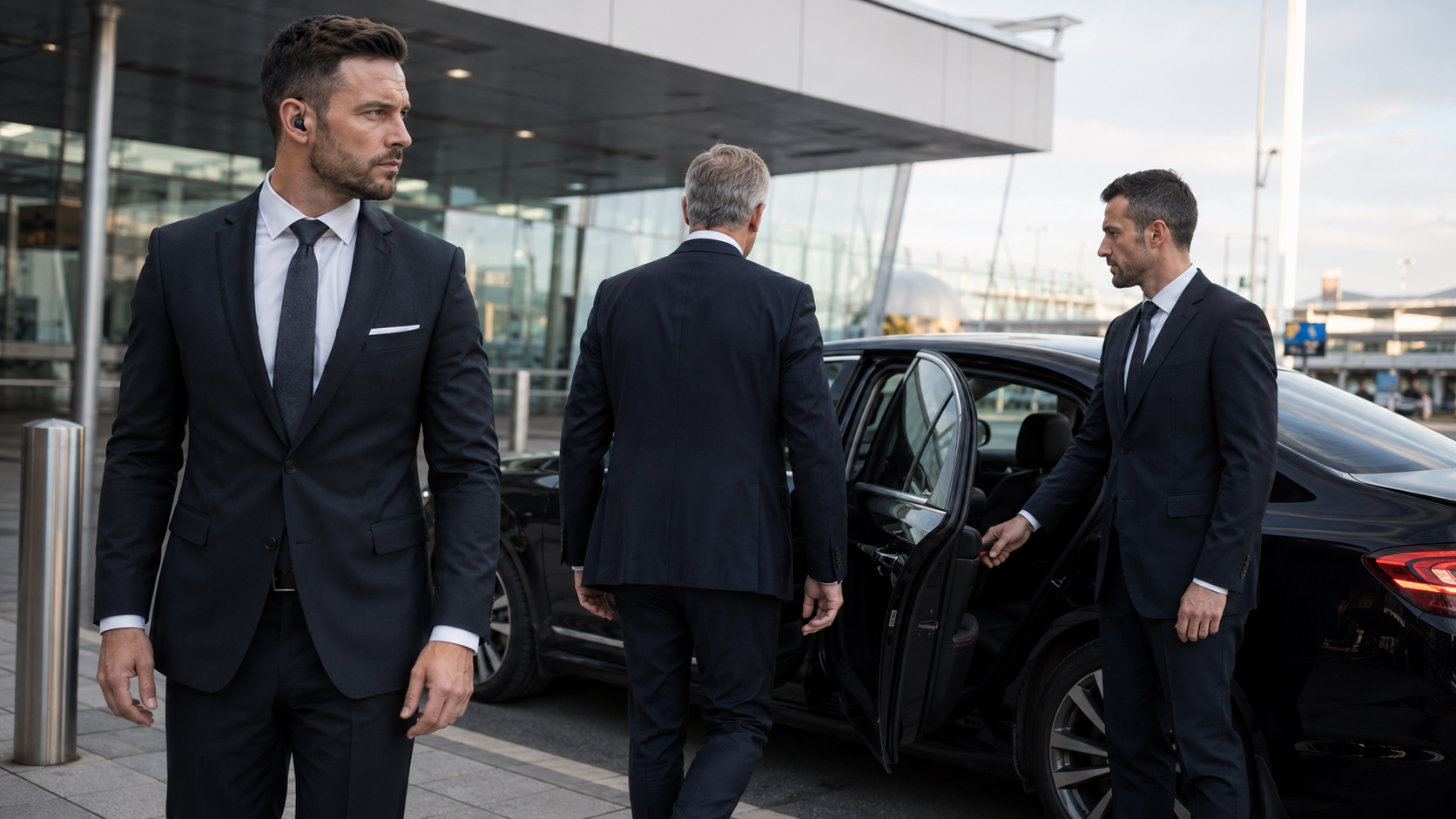
Private close protection is not about looking intimidating, projecting toughness or displaying readiness for confrontation. A close protection officer (CPO) must, of course, be capable of responding. They must be physically competent, psychologically resilient and prepared for fast-moving incidents. But physical intervention is only one layer of the role – and normally the last.
In practice, far greater value lies in what happens beforehand: assessing the venue, analysing routes, reading the environment, liaising with site personnel, selecting the safest access point, preparing alternatives, managing the principal’s exposure, identifying unusual behaviour and reducing risk before an incident develops.
None of this is particularly dramatic. Often, nobody notices it at all. That is precisely the point.
Good close protection frequently looks calm. Not because nothing is happening, but because much of what could have happened was anticipated and managed in advance.
Executive Protection Is a High-Trust Professional Service
The client is not simply paying for a physical presence beside the principal. They are purchasing reassurance, discretion, predictability, competent organisation and effective risk reduction – delivered without unnecessarily constraining the principal’s daily activities.
A principal in the private sector does not function as a component of a state protocol. They have meetings, travel commitments, business responsibilities, family life, personal requirements and their own preferred way of working. They may change decisions, depart from an agreed schedule or expect the protective team to remain unobtrusive rather than dominate the environment.
A CPO must therefore understand both the service relationship and the distinction between the client who commissions the service and the principal who receives protection. The role is to support the principal, not to take control of them; to advise, not lecture. Firmness is required when safety genuinely demands it, but on an ordinary day the protective team should remove problems from the principal’s path, not create additional ones.
This transition can be difficult for people who have spent years in systems built around orders, hierarchy and institutional authority. A service background may be an asset in the private sector, but it does not replace the ability to work professionally with clients and principals.
Protection Must Not Create Tension Around the Principal
Professional protection should never raise the temperature of a situation unnecessarily. More directly, the protective presence must not create tension around the principal, because its purpose is the exact opposite.
The purpose of close protection is not to manufacture an atmosphere of threat, demonstrate force or signal that the principal is in an exceptional situation. It is to provide safety, reassurance, discretion and as much normality as circumstances allow.
This is a central principle in Global Protection Group’s approach: protection should reduce tension, not generate it. If the presence of the protective detail causes unease, attracts attention or prevents the principal from functioning normally, the protective posture has begun to undermine the protective objective.
An overly conspicuous stance, ostentatious positioning, nervous reactions, aggressive communication or demonstrative control of the surroundings can have the opposite of the intended effect. Instead of lowering risk, such behaviour may draw attention to the principal, provoke reactions from others and disrupt the natural flow of a meeting, journey or event.
A skilled CPO knows how to be present without becoming the centre of attention. They can observe without theatrics, correct a developing situation without creating friction and respond in a way that leaves the principal feeling secure rather than confined by their own protection.
Government Protection Has Institutional Support; Private Protection Operates Within Constraints

The difference between government and private protection is not simply the identity of the person being protected. It extends to the entire operating environment.
Protective operations delivered by state structures are generally supported by a far higher degree of formalisation, institutional capacity and inter-agency coordination. A visit may be underpinned by established procedures, advance work, secure communications, multiple supporting bodies and access to resources that are rarely available to the private sector. In private executive protection, a small detail may have to combine advance planning, logistics, protective intelligence, liaison and direct protective functions.
Work divided between several specialist units in a government structure may, in the private sector, fall to one person or a very small team. Someone must assess the route and venue, liaise with organisers, plan vehicle access and holding positions, account for media or public presence, prepare contingencies and then remain directly responsible for the principal during the assignment.
There is no unlimited budget. Streets cannot be closed simply because the principal is travelling to a meeting. The team does not have the same access to intelligence as government agencies, and extensive logistical, technical or analytical support cannot be assumed.
Private executive protection is usually delivered in ordinary civilian environments: hotels, restaurants, offices, airports, private residences, public spaces and business events. The team operates without special state powers, without control over the entire environment and without the ability to subordinate every activity to a protective protocol.
The protective detail works among members of the public and within functioning commercial or public venues that cannot be reorganised entirely around its needs. Communication, discretion, professional conduct and the ability to secure cooperation without escalation are therefore critical.
Private close protection consequently demands a broad professional skill set. A CPO must think operationally while acting as a trusted service professional. They must plan like a risk specialist, communicate like an adviser, conduct themselves appropriately in a corporate environment and understand the consequences of every decision they make.
Professional Frameworks Reveal the True Breadth of the Role
Professional frameworks and international standards make clear that close protection is not a profession defined solely by strength, physical capability or prior service.
The breadth of the role is clearly reflected in the Security Industry Authority’s Knowledge and Skills Specification for Close Protection, which underpins the UK licensing framework. Alongside direct protective activity, it addresses roles and responsibilities, threat assessment and risk management, personal and professional skills, and surveillance awareness.
It also covers search procedures for people, vehicles and premises; venue security; route planning; reconnaissance; journey management; and the planning and delivery of protective assignments.
This illustrates the true scope of the profession. A CPO is not simply the individual walking beside a principal. They must understand risk, routes, venues, human behaviour, logistics, communications, procedures, legal constraints, liaison requirements and the practical response to a developing incident.
The SIA framework also places importance on dynamic risk assessment, contingency planning, ongoing assessment and response, interpersonal and negotiation skills, team working, professional etiquette, and the management of time and resources.
These capabilities are not acquired automatically through service in the military, police or another government organisation. Some former service personnel will arrive with excellent foundations. Some will need to change the way they think and work. Others may discover that the private close protection environment does not suit them.
It must be said equally clearly that people without a uniformed-service background can also become highly effective close protection professionals. With sound judgement, observational ability, resilience, discipline, planning and communication skills, and a genuine willingness to learn protective procedures, they may develop into excellent CPOs. What matters is not only where a person has come from, but whether they understand what close protection actually requires.
Private Principals Change Plans; Protection Must Adapt
Government visits are normally highly structured. Timings, routes, venue security, inter-agency coordination and responsibilities are planned in advance. Changes, pressure and unforeseen events still occur, but the system is designed to reduce uncertainty wherever possible.
A principal may change the day’s programme in the morning, select a different meeting venue at the last minute, delay a departure, invite additional guests, change hotels or decide to travel unexpectedly. For the principal, this may simply be normal life. For the protective detail, it is a new risk picture that must be assessed quickly.
This is not improvisation in the sense of relying on instinct alone. It is controlled flexibility, adaptive planning and dynamic risk assessment. A new route introduces new vulnerabilities. A new venue means different access points, surroundings, staff, parking arrangements and emergency egress options. An unplanned journey requires rapid assessment of transport, accommodation, local conditions and contingencies.
Situations of this kind expose the difference between someone who merely accompanies a principal and a professional who actively manages risk.
It is rarely sufficient to say, ‘We are not doing that.’ A professional should be able to propose a safer way forward: a different route or departure time, another entrance, a revised movement plan, an alternative vehicle holding point or a more effective liaison arrangement with the venue.
In private executive protection, effectiveness often lies not in preventing the principal from pursuing their objectives, but in managing risk so that those objectives can be achieved as safely as reasonably practicable.
Travel Risk Management Is Part of the Role
A substantial proportion of executive protection involves travel, vehicle movements, hotels, airports, restaurants, conference venues and rapidly changing locations. Each creates a distinct risk exposure.
Close protection therefore increasingly intersects with travel risk management. ISO 31030 provides a structured approach that includes policy and programme development, threat and hazard identification, risk assessment, and prevention and mitigation strategies.
In practical terms, the principal’s safety does not begin at the vehicle door. It begins much earlier, with an assessment of the journey’s purpose, route, transport, accommodation, local environment, potential disruption and contingency options.
Interpersonal Skills Are Not an Optional Extra; They Are Fundamental

It is easy in this profession to overvalue hard skills and undervalue the qualities that determine the standard of day-to-day delivery.
A CPO works closely with another person, often for extended periods and in highly private settings. They may see the principal’s family, colleagues and business partners, as well as fatigue, stress, vulnerabilities, private situations and difficult decisions. The officer must maintain discretion, tact and appropriate professional distance. They must know when to speak, when to remain silent, when to recommend a change and when not to turn a minor issue into a larger one.
Communication is central to private protection: with the principal, executive assistant, driver, hotel reception, restaurant staff, event organiser, venue security, family members and other participants in the day’s programme. Success often depends on securing cooperation without inflaming emotions or unnecessarily asserting authority.
That requires social competence, patience, sound judgement and the confidence to communicate without creating unnecessary friction.
Response Matters, but Prevention Matters More
One of the most serious misconceptions in close protection is that the role only becomes meaningful at the moment of confrontation. In reality, professional protection begins much earlier.
The UK’s National Protective Security Authority (NPSA) describes protective security through the principles of Deter, Detect, Delay, Mitigate and Respond. This makes clear that response is only one component of an effective protective system, not its starting point.
The same logic applies to close protection. If physical intervention becomes necessary, it may indicate that earlier protective layers have failed, or that the circumstances were exceptionally adverse. This is why planning, reconnaissance, environmental awareness, exposure management and rapid decision-making in changing conditions are so important.
The best protective actions are often the ones nobody later talks about. There was no struggle, no shouting, no footage circulating online and no incident that escalated beyond control.
Because someone identified the problem early. Because the route was changed. Because venue staff were engaged. Because a different entrance was selected. Because someone recognised that an apparently minor detail was about to become a genuine threat.
Prior Service Is a Foundation, Not a Guarantee
Military, police or other government-security experience can provide an excellent foundation, but only where the individual can adapt to a different operating logic.
Moving from uniformed service into private close protection is not a change of clothing. It is a change of mindset: from institutional authority, intervention and hierarchy to professional service, prevention, discretion and responsibility for enabling the principal to function safely and effectively.
The objective is not to dominate the environment, import a military narrative or transfer methods from combat and law enforcement into the principal’s private and professional world. It is to deliver security discreetly, effectively and proportionately.
A former soldier, police officer or government security professional may become an excellent CPO – not because they once wore a uniform, but because they understand that close protection is a distinct profession, more service-oriented, relational and preventive, and heavily dependent on planning and risk management. Equally, someone without a service background can succeed if they possess the right aptitude, ethics, discipline, resilience and commitment to specialist training.
This is why Global Protection Group’s training, advisory work and professional publications place emphasis not only on protective techniques, but also on mindset, communication, discretion, risk assessment and a proper understanding of the relationship between client, principal and protective team.
The most effective close protection professional is not the person who most closely resembles an action-film stereotype. It is the one who enables the principal’s day to proceed calmly, safely and in support of their objectives – even when plans change repeatedly, resources are limited and the work that makes the greatest difference remains unseen.
This article was originally published in the 03/2026 special issue of SPECIAL OPS magazine. It forms part of a series of articles developed by the Global Protection Group team in response to the many questions we receive about close protection work and training. Each article aims to provide a clear and reliable explanation of key issues in close protection, address common areas of uncertainty and correct widely repeated misconceptions.