



Counter-surveillance measures are still frequently associated with clandestine government operations or scenes from spy thrillers. However, in the realities of today’s business environment—particularly across Central and Eastern Europe—protection against illicit eavesdropping and recording has become a fundamental aspect of corporate risk management strategy.
What is Technical Surveillance Counter Measures (TSCM)?
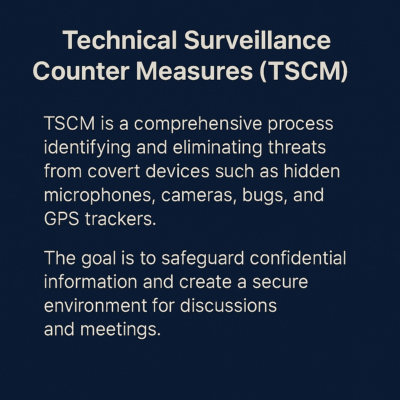
TSCM (Technical Surveillance Counter Measures) is a structured process designed to identify and eliminate surveillance threats posed by unauthorised listening or tracking devices. This includes hidden microphones, covert cameras, bugs, and GPS trackers. The primary objective of TSCM is to detect and neutralise these devices to provide a secure environment for confidential communications and executive meetings.
Why is this relevant for modern enterprises?
Regardless of industry, companies operating in this region must approach the threat of corporate espionage with due seriousness. Especially in light of current geopolitical volatility, the risk of intelligence breaches has significantly increased. TSCM is no longer a luxury—it is a necessity. Trade secrets, strategic plans, negotiation results or upcoming mergers can be of enormous value to competitors or hostile third parties.
Three key phases of an effective TSCM protocol
-
Detection of surveillance devices
Advanced equipment is used to identify concealed threats, such as spectrum analysers, wireless device detectors, cable and semiconductor junction scanners, and thermal imaging cameras. These tools can effectively pinpoint radio signals and recording devices, even those meticulously hidden from plain sight.
-
Threat neutralisation
Once a device is discovered, it must be swiftly neutralised. This may involve physical removal, deactivation, or in more complex scenarios, controlled use to feed false information—thereby exposing the entity responsible for surveillance.
-
Regular inspections as a preventive measure
One-time inspections are insufficient. Regular checks of strategic areas—such as executive offices, boardrooms, company vehicles, and the private residences of senior personnel—are essential. These not only help prevent incidents but also serve as a powerful deterrent to would-be intruders.
Securing executive meetings – a business imperative
High-level business meetings, particularly those related to confidential projects, strategic decisions or negotiations, are prime targets for illicit surveillance. TSCM plays a vital role in ensuring such discussions remain private and protected.
Prior to key meetings, organisations should conduct thorough room inspections and implement real-time technical safeguards during the meeting itself. Maintaining the integrity of the conversation space is no longer a precaution—it is standard due diligence.
Protecting business travellers from surveillance threats
Executives who travel frequently for business are especially vulnerable. Hotel rooms, conference facilities, taxis, and even lounges can be compromised. Temporary working environments are inherently risk-prone.
For this reason, regular TSCM inspections at hotels and meeting spaces, along with the use of portable bug detection devices, are crucial to protecting sensitive data and maintaining operational confidentiality during travel.
Tangible business benefits
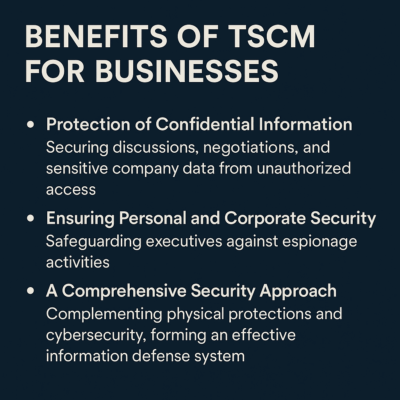
- Safeguarding confidential information – ensures that sensitive discussions, data, and negotiations remain secure and inaccessible to unauthorised entities.
- Enhancing executive and corporate security – protects senior leadership and key decision-makers from targeted espionage activities.
- Creating a holistic security strategy – TSCM complements physical security measures and cybersecurity, forming a robust, multi-layered approach to information protection.
Final thoughts
Forward-looking organisations cannot afford to ignore the risks associated with technical espionage. Responsible business leadership means protecting not only systems and data—but also the spaces where strategic decisions are made.
TSCM is no longer a niche service for select few—it is now an essential element of every comprehensive corporate security framework.
Want to know more? Check it out or contact us via email: gpg@globalprotectiongroup.eu
FAQ
What is TSCM?
TSCM (Technical Surveillance Counter Measures) is a counter-surveillance process focused on detecting and neutralising devices used for illicit intelligence collection, such as covert microphones, cameras, bugs, and GPS trackers.
When should an organisation consider a TSCM inspection?
Most commonly before sensitive meetings (negotiations, tenders, M&A), when there is suspicion of a leak, and as part of periodic preventive checks of critical rooms and executive environments.
Is a one-time sweep enough?
In practice, no. A one-off inspection improves security in the moment, but sustained resilience requires recurring inspections and a risk-based schedule aligned with business activity and exposure.
Which areas are typically covered by TSCM services?
Typically: boardrooms, executive offices, key departments, company vehicles, and temporary locations such as hotels and meeting facilities during business travel.
What are the real business gains from TSCM?
Reduced risk of information compromise, stronger executive protection, and a complementary security layer that reinforces physical security and cybersecurity within a unified corporate security model.
SUMMARY
Key takeaways
- TSCM helps detect and neutralise covert microphones, cameras, bugs, and GPS trackers.
- In Central and Eastern Europe, technical espionage is a realistic business risk.
- Effective TSCM relies on detection, neutralisation, and regular preventive checks.
- Business travel and temporary meeting spaces increase surveillance exposure.
Need to secure meetings and sensitive information?
If you want real reduction of eavesdropping and surveillance risk, explore our Special Services and TSCM capabilities.