



In close protection, I often see the same mistake: confusing presence with security. Someone stands very close to the protectee, looks intimidating, speaks loudly, and repeatedly signals “I’m ready.” It may look convincing, but it does not necessarily increase safety. In fact, it can do the opposite: it raises tension, draws attention to the protectee, and makes smooth, discreet movement harder.
In VIP protection the objective is straightforward: everything should run calmly and efficiently—without chaos and without creating a sense of threat for the protectee or those around them.
“Security theatre” — when security is just for show
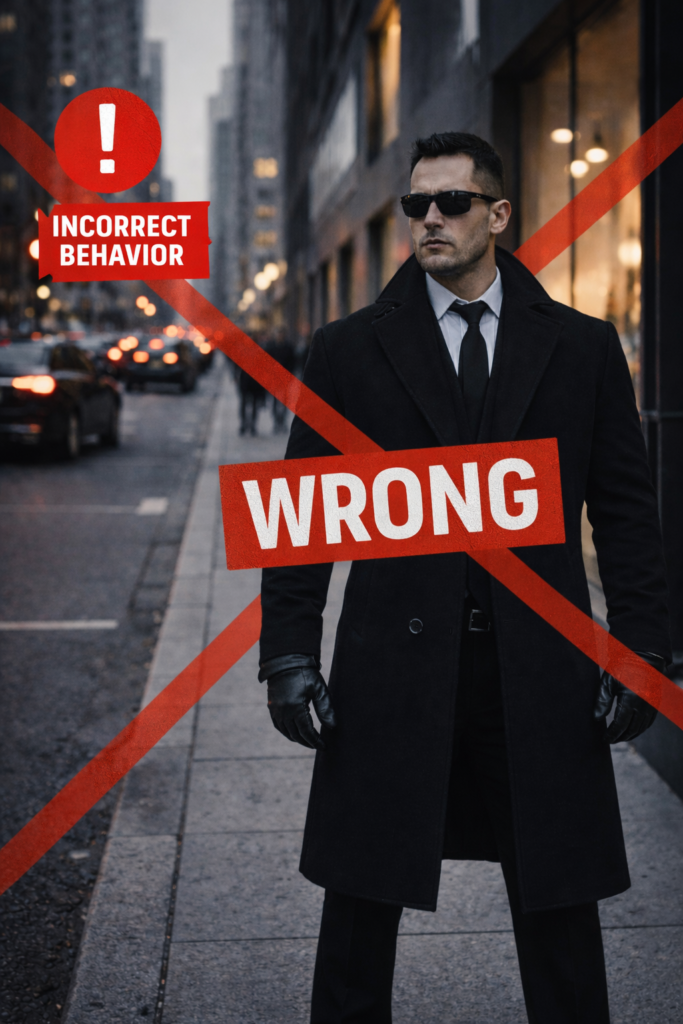
In the industry, the term security theatre is used to describe measures that look like “robust security,” but in practice add little to actual safety. In close protection, examples are often very simple:
- exaggerated “posturing” as if ready for confrontation,
- loud commands in public spaces without a real need,
- nervous scanning, pushing people, and unnecessary forced space-making,
- overtly staging actions in a way that bystanders start watching and reacting.
This can:
- increase bystander attention,
- encourage someone to “test” whether the protection team will react,
- reduce the protectee’s comfort,
- and sometimes disrupt the entire team’s work.
Professional protection is not about being visible. It is about operating effectively and calmly—providing security without raising tension and without attracting unnecessary attention.
The key work happens during preparation — before the event
The effectiveness of VIP protection largely depends on proactive measures taken well in advance—commonly referred to within the industry as advance or advance work. This means that before the protectee arrives:
- the venue has been reconnoitred (entries and exits, elevators, back-of-house areas, potential chokepoints),
- the route has been planned in advance (including contingencies),
- roles and areas of responsibility have been defined,
- a simple, unambiguous communications plan has been established,
- a realistic contingency plan has been prepared—one that can be executed in practice.
As a result, there is no need to “project force” on the ground—the situation is structured and controlled. And if events unfold differently than expected, the team has pre-planned options.
Security starts with information
Today, many problems do not appear “out of nowhere” at the last moment. They often build up earlier—for example:
- online and on social media,
- in announcements, comments, and warning indicators,
- in persistent behaviour by specific individuals,
- in business disputes or personal conflicts.
That is why protective intelligence is increasingly emphasized: the systematic collection and assessment of indicators that may signal rising risk. This is not “paranoia,” but standard information work—identify the signal, assess it, and respond early.
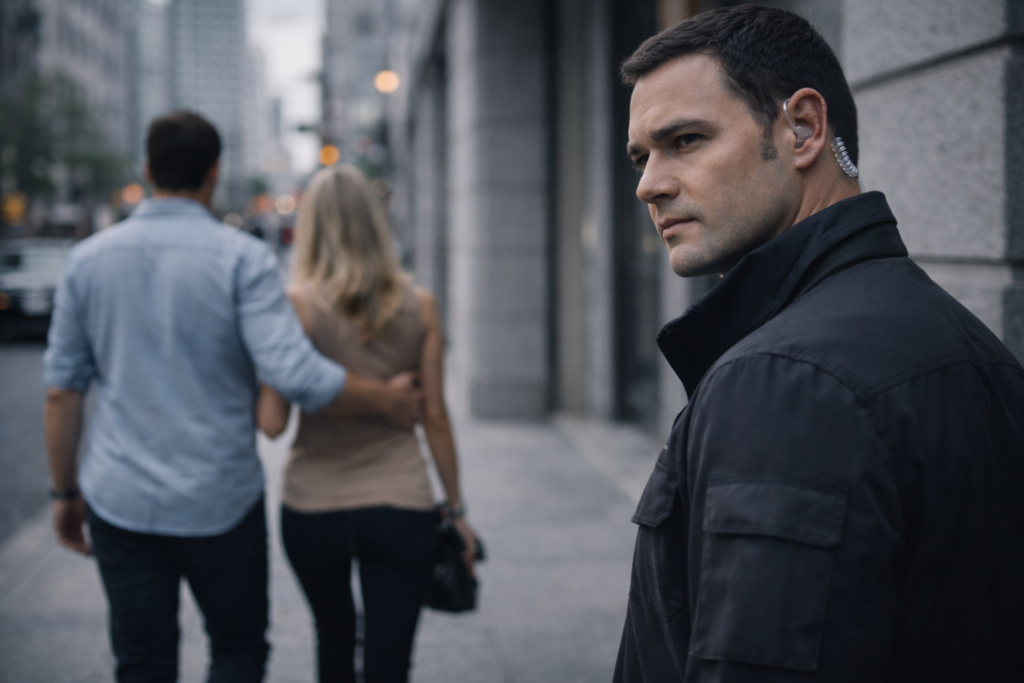
Calm is control, not passivity
The most effective protection professionals do not seek confrontation—they operate calmly and decisively.
This matters for one reason: real situations demand sound decisions under pressure. A simple framework that supports this is the OODA loop:
- Observe — notice what is happening
- Orient — understand context and the meaning of signals
- Decide — make a decision
- Act — execute quickly and consistently
A calm Close Protection Officer (CPO) moves through these steps faster and more accurately. A person driven by emotion is more likely to react too aggressively or too hastily—and instead of stabilising the situation, may unintentionally escalate it.
In a similar vein, the RPD model (Recognition-Primed Decision) describes how experienced professionals recognise patterns and select an appropriate course of action, rather than “considering everything” and reacting too late.
De-escalation is not “softness” — it is a practical method
In VIP protection, the best decision is the one that does not raise the level of conflict. De-escalation is a set of skills that allows a situation to be controlled without using force—primarily through:
- communication,
- correct positioning and positional control,
- maintaining safe distance,
- slowing the tempo of events,
- buying time for assessment and decision-making.
Many training programmes for law enforcement and close protection reinforce the principle of time, distance, communication. These are practical tools—not slogans.
In close protection this is especially critical, because unnecessary physical confrontation immediately creates additional risks:
- medical (injuries),
- legal,
- reputational,
- operational (crowd reaction, increased tension, and chaos).

The goal is “normality” — order and predictability
The best protection is the kind where:
- the protectee can operate freely,
- the environment perceives calm and strong organisation rather than nervous tension,
- the team is not forced to improvise at the last moment,
- potential issues are neutralised before they escalate.
That is why professional environments increasingly rely on clearly defined frameworks and standards (e.g., the ASIS Executive Protection Standard) and a risk-management-based approach—also in travel contexts (e.g., ISO 31030:2021 – travel risk management). Whether you operate in a small team or a large organisation, the principle is the same: the process must work—not just the “effect of presence.”
A control question to close
If you are considering work in close protection or you are responsible for people’s safety, ask yourself one question:
Does your work give the protectee more calm and freedom—or does it only make it more obvious that they have protection?
The best professionals are not the loudest. They are the most predictable for their team, the calmest in difficult moments, and the most reliable in execution.
There are situations where— for preventive reasons—protective actions must be intentionally visible and clearly communicate readiness to respond. However, this is a tool that should be used deliberately, in proportion to the risk level and the operational context, to avoid producing the opposite effect. More on when visibility truly works and how to implement it in practice in the next article.
FAQ
What is “security theatre” in VIP protection?
It refers to actions that look like strong security but do not improve real control of the situation. In extreme cases, they increase tension, draw attention to the protectee, and provoke reactions from the environment.
What does advance / advance work include?
Advance work is proactive preparation: venue recon, entry/exit analysis, route contingencies, team roles, communications, and a realistic contingency plan that can be executed in real conditions.
What is protective intelligence?
Protective intelligence is systematic information work: collecting and assessing indicators that may signal rising risk. The goal is to detect issues early and reduce risk before escalation.
Why is calm essential in VIP protection?
Calm improves control, increases decision accuracy under pressure, and reduces accidental escalation. It helps the team move efficiently through OODA: observe, orient, decide, act.
How does de-escalation work in practice?
De-escalation means controlling a situation without force: through communication, positioning, maintaining distance, and “buying time” for assessment and decisions. It reduces medical, legal, reputational, and operational risk.
When does visible protection make sense?
In some scenarios (preventively), security actions must be visible and unambiguous. The key is to ensure visibility is proportional to risk and context—so it does not create the opposite effect.
The above article is part of a series developed in response to frequent questions regarding work and training in the field of close protection. Each text aims to provide a reliable overview of key issues related to personal protection, as well as to organise the most common questions and correct widely repeated misconceptions.
SUMMARY
Key takeaways
- Presence does not equal protection — the real value is process, preparation, and control.
- Security theatre can raise tension and increase bystander attention.
- Advance work matters most: recon, route contingencies, roles, comms, and a realistic plan B.
- Protective intelligence helps detect risk early—before it becomes an incident.
- Calm decision-making under pressure (OODA / RPD) stabilises the environment and reduces escalation risk.
- De-escalation reduces medical, legal, reputational, and operational exposure.
NAVIGATION
Table of contents
Want to improve your security level or verify your current protection?
If your goal is real risk reduction—or you want to check whether current measures match your threat profile—base decisions on process, preparation, and operational control (not just “presence”).
Want to build real VIP protection competence through training?
If you want to structure your knowledge and practice real close protection scenarios—review the training format, scope, and the competencies developed during the programme.